

Cell Therapy
Cell therapy refers to the technology of utilizing human cellular and tissue-based products to reconstruct human structures, restore functions, or treat diseases. This approach involves isolating, culturing, and expanding cells ex vivo (outside the body) before reintroducing them into the patient to target and treat specific medical conditions.
Based on the cell types utilized and their clinical applications, the field is primarily divided into two core areas:
- Immune Cell Therapy – Global R&D and clinical applications primarily focus on Natural Killer (NK) cell therapy, T-cell therapy (such as CAR-T), Dendritic Cell (DC) therapy, and therapies targeting autoimmune diseases. The U.S. National Institutes of Health (NIH) has officially recognized immune cell therapy as the “fourth major modality of cancer treatment,” alongside surgery, radiotherapy, and chemotherapy.
- Stem Cell Therapy Stem cells possess unique “differentiation potential” and “self-renewal capacity,” marking a revolutionary breakthrough in regenerative medicine. Currently, stem cell therapy is widely applied to address long-standing medical bottlenecks, bringing new therapeutic hope to patients suffering from conditions that lack effective conventional treatments, including diabetes, stroke, myocardial infarction, renal failure, Alzheimer’s disease, Parkinson’s disease, and other degenerative disorders.
Human Cellular Therapeutic Products: Regulatory & Safety Outlook
To ensure that human cellular therapeutic products meet the highest standards of scientific validity, safety, and ethical integrity during the clinical trial stage, and to substantially safeguard the rights of trial participants, the Taiwan Food and Drug Administration (TFDA) has established the “Regulations and Criteria for the Review of Human Cellular Therapeutic Product Clinical Trial Applications.”
For the clinical translation of cell therapy products, regulatory authorities have instituted rigorous quality control and safety evaluation systems.
The Regulatory Crux for Pluripotent Stem Cells (PSCs) – Cell products derived from induced Pluripotent Stem Cells (iPSCs) or Embryonic Stem Cells (ESCs) carry inherent risks of tumorigenicity and safety concerns that are significantly higher than those of adult stem cells and somatic cell products, due to their capacity for “infinite self-renewal” and “multilineage differentiation.”
Consequently, drug development teams must establish stringent preclinical evaluation standards to comprehensively validate the following core indicators of cellular preparations:
- Consistency
- Stability
- Biodistribution
- Tumorigenicity
- Toxicity
- Immunogenicity
Clinical Trial Process for Cell Therapy Products
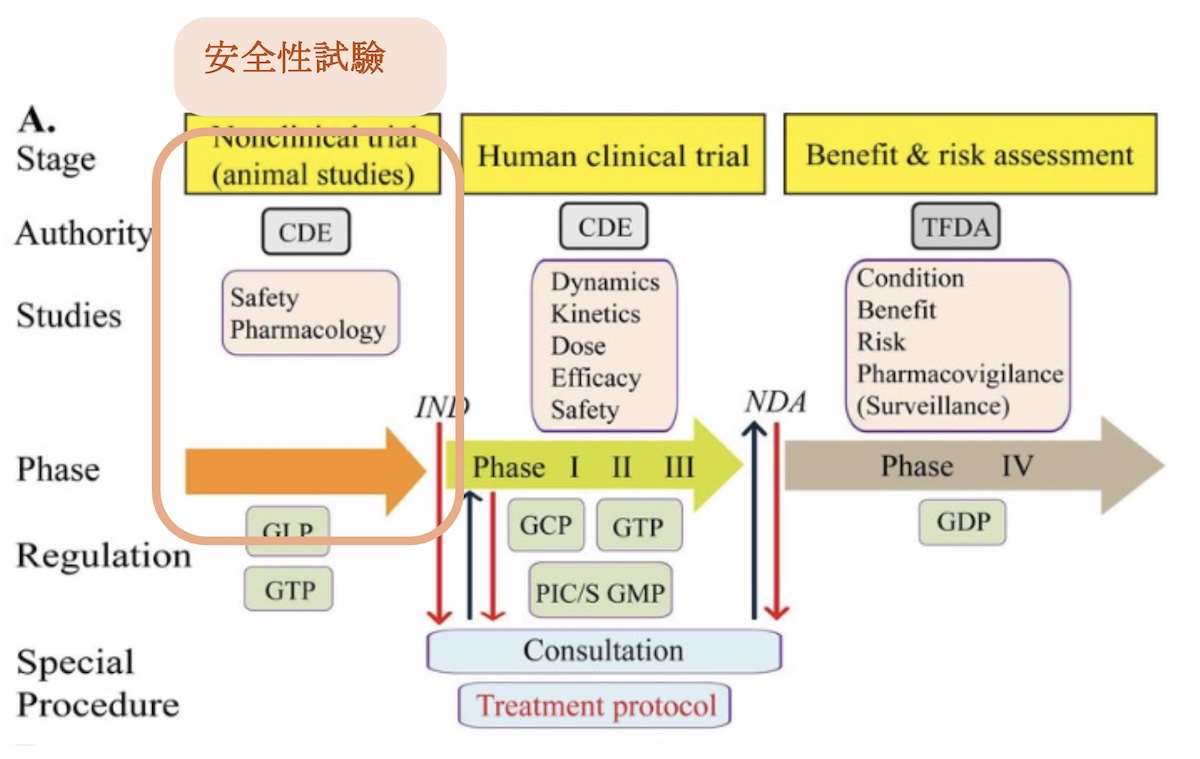
Reference : Cell Transplantation, Vol. 26, pp. 483–492, 2017 (DOI: https://doi.org/10.3727/096368916X693293)
Trifecta MedTek: Full-Service Preclinical Safety Evaluation
Leveraging our cutting-edge core technologies, internationally compliant facilities, and expert scientific team, TMT provides comprehensive and critical safety evaluation solutions required for cellular therapeutic products prior to clinical trial applications:
1. Tumorigenicity Assessment
When cell products undergo expansion or directed differentiation in vitro, differentiation efficiency rarely reaches 100%, and standard purification processes may not completely eliminate undifferentiated cells. Studies indicate that these residual, incompletely differentiated cells can form tumors (such as teratomas) at the target site or after migrating to other organs post-implantation. Therefore, verifying that stem cell therapies do not induce tumorigenicity is a critical safety consideration.
2. In Vivo Biodistribution Study
Due to the potential risks that clinical tracking agents and labeling technologies pose to human subjects, it is currently challenging to acquire comprehensive cellular distribution data directly within the human body. Consequently, whether cells distribute to intended or unintended target locations, as well as their in vivo persistence, must be elucidated through robust animal biodistribution studies. TMT utilizes molecular biology and live imaging tracking platforms to rigorously assess whether implanted cells lead to abnormal tissue hyperplasia or other potential safety concerns.
3. Immunogenicity & Immunotoxicity Analysis
When stem cell products are prepared for human clinical trials, HLA (Human Leukocyte Antigen) matching between donors and recipients must be evaluated. Furthermore, systematic in vitro and in vivo assays must be conducted during the preclinical phase to evaluate potential antigenicity or immunotoxicity induced by the cell product. TMT offers all-inclusive immunotoxicity evaluation services to ensure your cell product complies with the highest standards of regulatory review.